Showing posts with label Proper People. Show all posts

Saturday, 28 January 2017

Curious Anomaly in South Yorkshire Asylum Records

To help accommodate the growing numbers of pauper lunatics requiring treatment in the West Riding of Yorkshire, the South Yorkshire Asylum, much later known as Middlewood Hospital, was opened at Wadsley near Sheffield in August 1872.

South Yorkshire Asylum, Wadsley, Sheffield c 1928. (Sheffield Local Studies Library)
Four years earlier the West Riding Pauper Lunatic Asylum had rented a large property, Mount Pleasant in Sharrow Lane, Sheffield which had been run as an annexe housing 75 patients. These patients were among the first removed (transferred) to take up residence in the new asylum. By the end of 1872, over 250 patients, all chargeable to the poor law Unions in the south of the Riding – Sheffield, Worksop, Eccleshall Bierlow, Rotherham, Wortley, Penistone, Thorne and Doncaster – had been removed from Wakefield to Wadsley, freeing up significant accommodation in that asylum. This movement of patients between asylums would continue throughout subsequent years as the West Riding authorities tried to cope with the ever rising demand for asylum beds.

For the genealogist, Sheffield Archives in Shoreham Street, Sheffield holds the surviving patient records for the South Yorkshire Asylum. Unfortunately, only patient admission registers exist for the period 1872 – 1915. Thereafter I am led to believe that patient case notes do exist but I have been unable to view those myself because of the 100 year restriction on access.

Some seven years ago, enthusiastic volunteers from Sheffield and District Family History Society undertook the transcription of the early admission registers covering 1872 - 1910. Their transcriptions have since been made available to researchers through Sheffield Archives website where you will find four downloadable PDF files organised alphabetically by patient’s surname, acting as the index to the actual admission registers.

More recently, the great work done by the Sheffield team has found a wider audience through the subscription website Findmypast where the 17,368 admission records have been made available under “Hospitals” in “Institutions & organisations”. Anyone searching for an ancestor might well find a record suggesting that they had been a patient in the South Yorkshire Asylum.

There is however a catch. The original admission registers have been accurately transcribed including the “age” of the admitted patient. From that age, a “birth year” has been calculated which is also shown in the Findmypast record although no birth year is shown in the original admission register. We genealogists use that birth year when trying to verify that we have got the right person so tend to place a great deal of store by it. For any patients admitted directly into the South Yorkshire Asylum their age on admission will allow a sensible estimate of their birth year to be calculated. The catch is that where a patient had been removed from Wakefield, the “age” recorded in the South Yorkshire Asylum admission register was actually their age on the date of their original admission to Wakefield.

William ROBERTS, 1871. Courtesy of WYAS.
For example, cutler William Roberts was admitted to the West Riding Pauper Lunatic Asylum, Wakefield in 1852, aged 40. I researched William’s case for my book Proper People and found that he had been removed to the South Yorkshire Asylum in 1872. The admission register entry for that institution has been correctly transcribed and appears on Findmypast as follows:

William’s age is shown as 40, his age on admission to Wakefield in 1852, so his real birth year was circa 1812. The actual year would depend on his date of birth which is why it is always a good idea to use +/- 1 year when carrying out online searches. The birth year shown here, 1832, is out by 20 years, long enough for another family generation, so having the real potential to confuse the researcher.

Other patients who appear in Proper People and were removed from Wakefield to Sheffield include Patrick GANNON, Alice BROADBENT and Charles WILCOX. Their birth years have been understated by 18, 20 and 31 years respectively. My guess is that 5 – 10% of the earlier Sheffield admissions will be for patients removed from Wakefield so are highly likely to show an incorrect age and birth year.


Admission Register Entry for Charles WILCOX (Second from bottom).
Courtesy of Sheffield and District FHS.

This is an odd situation as nobody has actually made a mistake. The admission records had been faithfully transcribed and the data held on Findmypast is a true copy of those transcriptions.
When I brought this curiosity to the attention of Findmypast their response was that they accept transcriptions from third parties in good faith and that I should take the matter up with the data owners, Sheffield and District Family History Society. I did indeed discuss this with a very helpful lady from the society and she was surprised to learn of the "problem". I understand that she is due to discuss the matter with Sheffield Archives with a view to perhaps including a warning that there is misleading data in some of the admission register entries. I would have thought that Findmypast should also publish a similar warning for its paying customers.

Without my having conducted research into asylum records in both the Wakefield and Sheffield Archives this oddity might never have come to light. The challenge now must be to identify all the hundreds of patients removed from Wakefield to Sheffield and establish their correct age, thence birth year. Some of those patients records hold a clue as, just in the case of Charles WILCOX above, their Previous Place of Abode shows Wakefield Asylum, but this is not consistent throughout the record set.

Any fortunate family historian coming across an ancestor in Sheffield who had been removed from Wakefield will have the added bonus of being able to access their pre Sheffield case notes which will be held by West Yorkshire Archive Service (WYAS) and those may just contain a wonderful old photograph, as I found in the case notes of William ROBERTS above.

Note that WYAS is currently closed but reopens in a fantastic new building, the West Yorkshire History Centre, on 13 February, 2017.

Thursday, 26 January 2017

Interview on BBC Radio Leeds


Back in 1966, a young Invernessian schoolboy was very excited to have been asked to participate in a "schools broadcast" on the Cairngorms for BBC Scotland. Fifty years later he was equally, and perhaps even more excited to have appeared on the Chris Stead morning show on BBC Radio Leeds.

I thoroughly enjoyed the experience and was not nearly as nervous as I’d expected.


Chris set the scene and then asked me some questions about Proper People. I think I managed to answer without too much hesitation or “humming”.


My biggest worry had been about the 10 minute slot and how I could turn that into a sensible interview when I’d be very happy talking on my favourite subject for hours. Needn’t have worried as Chris managed it just nicely. Unlike me, he had clearly done it before!

Thank you so much to producer Sarah Whitham for the invitation. Amazon statistics suggest that I might even have attracted a few more readers.

Listen below to my interview which is reproduced with the kind permission of BBC Radio Leeds.


Tuesday, 22 November 2016

Explore Your Archive 2016 - Hairy Archive Day

Today is “Hairy Archive” day in this year’s Explore Your Archive campaign. Archivists across the country have been scouring their collections to tweet examples of unusual references to hair and illustrations or photographs of hair or hairy things which can be found in their archives. Examples have included this photograph submitted by The National Archives of a Mrs Dawson from Grays, Essex who won 1st Prize in the Hair Competition at an amusement park known as the Kursaal in Southend-on-Sea, Essex on 19th August, 1908. Her hair must be all of 5 feet long.

Victorian gentlemen feature on many of the tweets, sporting impressive beards and moustaches so there is a preponderance of well groomed, male facial hair.

Casebook F5 in the West Riding Pauper Lunatic Asylum archives held by West Yorkshire Archive Service, Wakefield holds something hairy and different dating from 1843. Sadly no photographs at that time and no illustration so I’m stealing a few paragraphs from my book Proper People where I write briefly about one of the patients, including a transcription of her physician’s entry in her case notes.

Forty-one year old Martha BELL from Bilton cum Harrogate was readmitted to the Asylum on 10th February, 1831, having previously been discharged, cured, on 20th March, 1826. Her case notes contain a surprising description of Martha. 
December, 1843. Face pale, features coarse and strong, chin covered with a beard 9 or 10 inches long, which she wraps up in curl-papers: she is demented and deluded, has a most violent temper and noisy tongue if anything irreverent is said of her beard on which she prizes herself. 
On this occasion Martha BELL spent over 30 years in the Asylum before her death, at the age of 71, on 14th May, 1861.
So it not just well-groomed male facial hair which can be found in our archives!

Friday, 28 October 2016

Announcing Release of Proper People as eBook

Following numerous requests from the public I am pleased to announce that digital versions of Proper People. Early Asylum Life in the Words of Those Who Were There are now available to pre-order on Amazon, iTunes Store and Kobo priced at £9.99.  They will be delivered from 1st November 2016.

Monday, 10 October 2016

Patient's "Drone" View of West Riding Lunatic Asylum

We now almost take for granted the ability to capture aerial photographs from a remotely controlled drone buzzing its way above our streets and buildings. Back in 1861, one talented inmate from Leeds was able to visualise what the West Riding Pauper Lunatic Asylum would look like from a point several hundred feet in the air above and like the drone pilot today, his feet never even left the ground. With no digital photographs to work from he then captured his vision in a drawing which would be certified for its accuracy by the County Surveyor of the West Riding himself.

I first saw a print of that drawing in the Mental Health Museum in Wakefield some years ago. As someone who cannot draw to save himself, I was particularly impressed with the skill displayed to produce such an accurate view.

The artist, James WALKER, does appear in Proper People but I have today posted an article on my Early Asylum Life blog which explores his amazing drawing in considerably more detail. You'll perhaps imagine yourself flying through the Wakefield sky 155 years ago.

Enjoy!  

Thursday, 22 September 2016

Wellcome Library's "Anonymous Patients" Become Proper People

When doing the research for my book, Proper People. Early Asylum Life in the Words of Those Who Were There it was always a very special “gold nugget” moment to turn a page in one of the early volumes of original case notes and find myself looking at a photograph of the person who had been a patient in the West Riding Pauper Lunatic Asylum (WRPLA), Wakefield. The earliest photographs in the records date from around 1868 but it would be many years before all patients were routinely photographed.

Today, outside of the West Yorkshire Archive Service (WYAS) in Wakefield, there are two collections of similarly styled photographs of WRPLA patients annotated with apparently diagnostic phrases such as “Mania of Suspicion” or “Mono-mania of Pride”. The majority of the photographs are held by the Darwin Correspondence Project (DCP) at Cambridge University and another thirteen survive in the collection of the Wellcome Library, London.

The DCP photographs were originally sent to naturalist Charles Darwin by the Superintendent of the WRPLA in Wakefield, England, James Crichton-Browne, ahead of and after Darwin’s publication of The Expression of the Emotions in Man and Animals in 1872. This collection holds 30 WRPLA patients’ portraits, one photograph annotated “The Insane Ear” and five other photographs. A group photograph, thought to be a montage, has been credited to being that of a family of patients held in the Crichton Royal Hospital, Dumfries and a photograph of a female patient with “large” hair is also believed to have originated elsewhere. Three unannotated portraits are of a style unlike any of the myriad of WRPLA patients’ photographs from those times suggesting to me that Crichton-Browne had also obtained those from another source.

In recent years these photographs have been referenced by essayists and authors. In Darwin’s Camera Phillip Prodger writes about Darwin’s use of art and photography in the theory of evolution. One of the photographs from the DCP used by Phillip was that of William DENTON who also features in Proper People. William’s second photograph is reproduced here courtesy of WYAS.

William DENTON, c 1869
William DENTON was a 37 year old unmarried plasterer from George Street, Sheffield before being admitted in May, 1865, suffering from dementia. He was in weak health, had a double hernia and it was thought he showed some symptoms of General Paralysis.

Ahead of his admission, surgeon James Walker had examined William and classed him “an idiotic lunatic”. He reported that William had twice attempted suicide, was very excitable, violent and broke furniture.

William was removed to the South Yorkshire Asylum, Sheffield in 1872 where the following year he passed away following surgery for a strangulated hernia.

There will be more about the Cambridge collection of WRPLA patients’ photographs in later posts but for now let’s look more closely at the Wellcome Library portraits.

Stassa Edwards in her excellent 2015 essay The Naturalist and the Neurologist: On Charles Darwin and James Crichton-Browne referring to the photographs sent by Crichton-Browne calls them “a group of now-anonymous patients” as beyond how they looked and the diagnostic label written on their photographs nothing else had been known of them. In her essay Stassa featured four photographs from the Wellcome Library and the reader could be forgiven for thinking that they had been among those shared in the correspondence between Crichton-Browne and Darwin. Those four Wellcome Library photographs are certainly of WRPLA patients but I cannot find any evidence to suggest that they were actually sent to Charles Darwin. If they were, why are they not part of the DCP collection?

William Schupbach of the Wellcome Library has kindly confirmed the provenance of the photographs which were purchased at Sotheby's sale in London on 6th November, 1987. They had been put up for auction by descendants of Dr Henry Clarke to whom the photographs were attributed. In 1987 Henry was said, incorrectly, to have been Medical Superintendent of the West Riding Asylum, Wakefield.

So was Henry Clarke responsible for taking the portraits in the Wellcome collection? Laura Sellers of the University of Leeds has previously pointed out to Wellcome that Henry Clarke did not arrive in Wakefield until early 1876 to take up the position of Chief Medical Officer of the West Riding Prison and Convict Centre. While he did collaborative research with the WRPLA in the late 1870s he was never employed there.

The Yorkshire Post and Leeds Intelligencer of 17th December, 1875 carried a brief article telling us more about Henry Clarke’s background.

Henry Clarke had become a registered doctor in December, 1874 having studied medicine for the previous six years at Guy’s Hospital in London. There is nothing known to connect him with Wakefield ahead of him taking up his post at the House of Correction in early 1876. That is important as my research into the Asylum case notes has shown that twelve of the thirteen Wellcome photographs had been taken between 1871 and 1873 so it is safe to conclude that Henry Clarke was not the photographer.

James Crichton-Browne was Asylum Superintendent at the time those photographs were taken. While he may or may not have actually operated the camera it was he who had first introduced the use of photography in the Asylum, possibly as early as 1868, and he would almost certainly have selected the patients to be photographed. It is wholly appropriate that Wellcome Library now attribute the photographs to Crichton-Browne.

It is time that the “anonymous” photographs held by Wellcome Library become those of proper people as they were simply real folk struggling to cope with their mental illness and should not remain nameless exhibits from our archives. Let me first introduce you to the four patients who all featured in Stassa's essay. Their photographs are reproduced here courtesy of the Wellcome Library, London.

Ellen SUTCLIFFE, 1873
Imbecility
Twenty six year old Ellen SUTCLIFFE from Wheatley, Ovenden near Halifax had been admitted to the Asylum in April, 1865 from Halifax workhouse. She was married to dyer Aaron and they had two children. William Alexander had examined Ellen ahead of her committal and recorded the following observations to support the case for her being considered a lunatic.

That she is whining and crying out "Oh Dear". That she fails to reply to my enquiries, that she is desponding and now crying out loudly for her father. That Mrs Haigh tells me she has been obliged to confine her in the padded room at the Workhouse, that she attempted to throw herself and infant out of the window a week ago.

Ellen's photograph was taken in 1873.

In July, 1884 Ellen was dancing in the main hall of the Asylum when she had a seizure. Carried to bed she died shortly afterwards.

John Edward GARTSIDE, 1872
Consecutive Dementia

Nineteen year old bachelor John Edward GARTSIDE, a warehouseman from Roughtown, Mossley near Manchester was admitted to the Asylum in March, 1872.

John Edward’s insanity was indicated by “tearing his clothes also bedclothes. Attempting to strangle his mother.” He also “interrupted the service of the School Church by his incoherent manner”.

John Edward’s case notes suggest that his photograph was taken in July the same year.

He was discharged recovered in July, 1874.

Mary KEIGHLEY, 1873
Chronic Mania


Thirty two year old Mary KEIGHLEY, a married mill hand from Bradford was admitted in May, 1863 suffering from mania.

She is very restless and cannot sleep at night roams about the house all day talks all sorts of nonsense. Says she sees the Catholic Bishop with woman up stairs and other men with various women all which are false.

In Mary’s case notes her photograph is dated 1873.

Mary would spend the rest of her life in the Asylum. She passed away in June, 1896 and was interred at St Peter’s Parish Church, Stanley.


William HARDACSTLE, 1872
Mono-mania of Pride


William HARDCASTLE, was a 42 year old married labourer from Commercial Street, Morley admitted in November, 1871.

Several weeks earlier he had been knocked unconscious by a blow to the head from another man. His behaviour since had been erratic but it was his “doing his family duty” by beating his wife “for her own good” that appears to have triggered his committal to the Asylum.

William was discharged recovered in June, 1872 shortly after this photograph was taken.

Nine more WRPLA patients’ photographs are held by the Wellcome Library. Here are brief extracts from their case notes and reception paperwork the originals of which are held by WYAS in Wakefield, West Yorkshire.

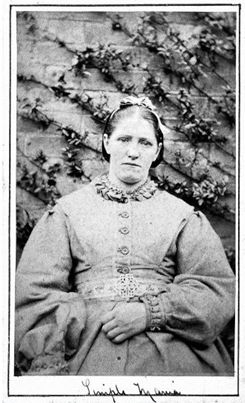
Mary SHAW, 1871
Simple Mania

Admitted in November, 1870 Mary SHAW was a married 35 year old from Lower Hanover Street, Leeds. During her six years of marriage she had given birth to four children. Three had died at the age of two years. Six weeks earlier her new-born baby had died aged just one week old.

Mary had said she would "send her husband to Gaol then get a velvet dress and have a second husband" probably inspired by the black eye he had given her.

Despite an attack of pneumonia by the following spring she was in good health. Mary was discharged in September, 1871, just one day after her photograph had been taken.

Emma PAGE, 1873
Mono-mania of Pride
Emma PAGE was a 36 year old widow from Lockwood near Huddersfield when admitted to the Asylum in May, 1866.

Emma suffered from delusions. She believed that all her food was poisoned, and that persons, including her brother, would enter her locked house and steal her documents and valuable property. The Queen of England and the Emperor of France were going to ensure that she took possession of large properties which she had in India and America.

This photograph of Emma was taken in 1873. Her case notes also contain an undated picture of a much older Emma. She was still wearing her hair in ringlets.

Emma remained in the Asylum until her death in July, 1911 from tuberculosis. She was 81 years old.

Ellen FOLEY, 1873
Acute Melancholia
Twenty two year old mill hand Ellen FOLEY from Reform Street, Bradford was admitted in May, 1861.

Her earliest case note states that Ellen was suffering from “mania characterised by her excited manners – talking and laughing and wandering about the ward breaking the windows”.

There would be no improvement in Ellen’s mental health and in 1873 her physician described her as being “almost completely demented”. Her photograph was taken that same year.

Ellen was transferred to the South Yorkshire Asylum, Wadsley near Sheffield in 1875 from where she was discharged four years later showing no improvement in her mental condition.

Curiously, her case notes make no mention of acute melancholia, the annotation on her Wellcome Library photograph.

Sarah THACKRAY, 1873
Consecutive Dementia
When 46 year old spinster Sarah THACKRAY from York Road, Leeds was admitted in January, 1871 it was her fourth visit to the Asylum. It would also be her last.

Her committal paperwork records observations made by surgeon Frederick Holmes who had examined Sarah the previous day.

She is constantly alarmed, restless, violent and excited. Talks wildly and incoherently and believes that those about her wish to rob her of her fortune and birthright.

This photograph of Sarah is dated 1873.

Sarah’s delusions persisted throughout the next 24 years only being brought to an end by her death in June, 1895 from chronic disease of her heart and kidneys.

Nancy FARRAR, 1873
Senile Dementia

Nancy FARRAR, a 45 year old single mill hand from Horbury, was admitted to the Asylum in June, 1852. She was said to have been suffering from melancholia for about 12 months.

This photograph of Nancy was taken in 1873 when she would have been 66 years old. She is the earliest admitted patient in the Wellcome Library collection.

In August that year her physician wrote:

Patient is getting much thinner though her mental condition is unchanged. She is under the impression that everyone about wishes to injure her and that she is consumed by the fire inside her.

Nancy’s health deteriorated with age and she passed away in the Asylum in June, 1886.

Elizabeth HARDCASTLE, 1872
General Paralysis of the Insane

Elizabeth HARDCASTLE was a 40 year old domestic servant from Bramley when admitted to the Asylum in April, 1872. Her photograph was taken two months later.

The Relieving Officer for Bramley provided Elizabeth’s recent history:

Patient has always been a weak minded woman but for the last two years her mind has become more effected. Since then she has been at one time violent, at another low spirited. She has been for fourteen years in the Workhouse not having had strength of mind to earn her own living. About three days ago she struck a man, swore she would commit murder and refused to do any more work.

Elizabeth would spend six years in the Asylum before being discharged relieved in July, 1878. Nowhere in her case notes is there any suggestion that she was suffering from General Paralysis of the Insane, the annotation on her photograph.

Peter FITZSIMONS, 1872
Mania of Suspicion

Only one photograph appears in both the Wellcome Library and DCP collections being that of Peter FITZSIMONS, a 50 year old married joiner from Rock Street, Leeds. Peter was admitted to the Asylum in March, 1872.

Leeds Union physician Frederick Hall presented the following opinion having examined Peter before his committal.

Talks in a rambling discursive style. Has exaggerated ideas of his wealth and position. Imagines that he has been insulted and ill-treated. Says that for the last 2 years he has been unable to retain a situation owing to the confused state of his mind and that he has frequently contemplated committing suicide. Appearance and manner generally that of a weak-minded person.

Peter was photographed in July, 1872.

Initially Peter worked steadily in the carpenter’s shop at the Asylum but from the end of 1872 his health slowly deteriorated. His death in April 1874 was recorded as caused by General Paralysis of the Insane, tertiary syphillis, of three years duration.

Charles GOULDTHORPE, 1872
Organic Dementia

Charles GOULDTHORPE was a 51 year old married labourer from Attercliffe Road, Sheffield when admitted in June, 1872. His photograph is dated that same month.

He was accompanied to the Asylum by a police officer who had this to say:

Patient has been in the workhouse about a fortnight and while there was at times depressed and refused his food and at other times excited. At times he has been very suicidally inclined but it is not known whether he has made any direct attempt on his life. He is thought to have been a steady and sober man. Nothing is known of his family history. The present attack is said to have lasted 6 weeks, but no reliable information can be obtained.

In November, 1872 Charles was removed to the recently opened South Yorkshire Ayslum at Wadsley near Sheffield.  He passed away there in November the following year.

William WILKINSON, c 1872
Melancholia

Twenty eight year old William WILKINSON, a married joiner from Leeds was admitted in October, 1866.  His "vacant looks and incoherent conversation" were reported as evidence of his insanity together with "his inability to attend to his occupation from mental incapacity".

In feeble health he was assessed as suffering from dementia. Within two months both his mental and physical health had improved and William had been set to work at his trade in the Carpenter's Shop. 

By April, 1875 there had been no improvement in his mental condition and there was concern over his deteriorating respiration.

William left the Asylum that same month when he was "discharged at the urgent request of his friends".


While we do not yet know who annotated the Wellcome Library collection of photographs and how they got into the hands of Henry Clarke at least they are no longer of anonymous individuals. They were proper people with families and now we know their names, how old they were, where they had lived, why they were in the Asylum and what had become of them. There is much more to learn about each of them beyond the brief thumbnail sketches included in this article but I do hope that I have inspired more of you to have a dig around in your local asylum archives. You never know who or what you might find.